What one exit question told me that analytics couldn't
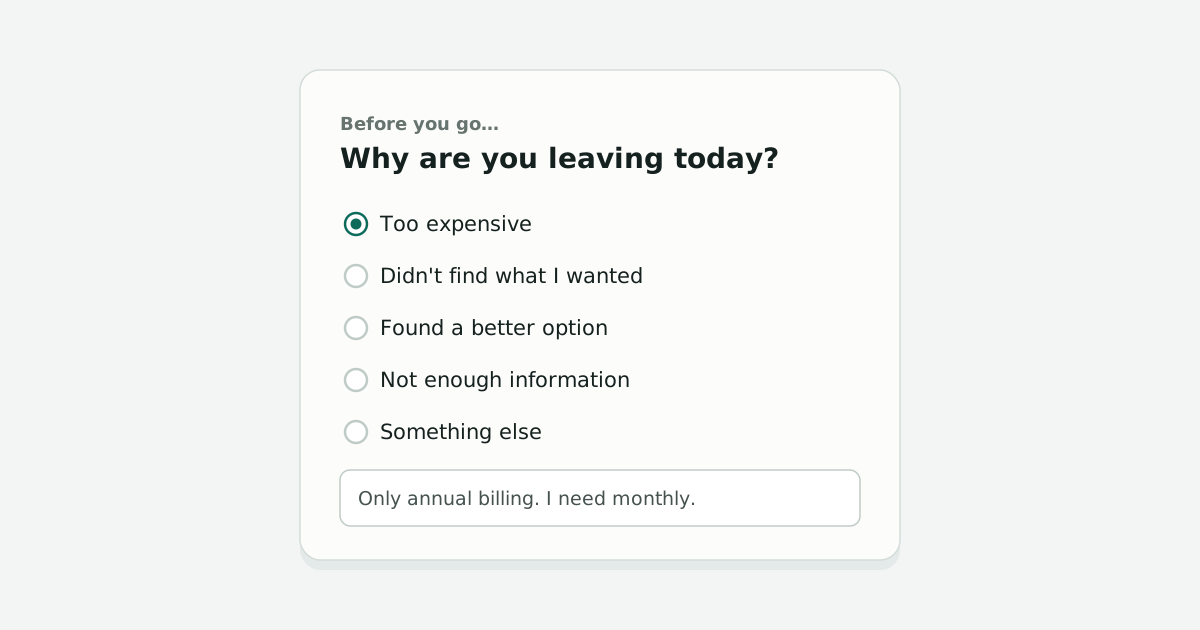
Analytics can tell you that people leave your pricing page. It can't tell you why. One question, asked as they leave, gets you surprisingly close.
At a previous company I ran a short exit survey on the site and analyzed a few thousand responses over a month. A few lessons apply to almost any business.
Keep it to one question
Ask why they're leaving, give a handful of fixed reasons, and add one optional text box. The fixed reasons give you numbers you can track. The text box gives you the words. Ours offered reasons like "too expensive", "didn't find what I wanted", "found a better option", "not enough information", and "site not easy to use", plus "something else".
Fewer options is better. Every extra choice splits the answers thinner and makes the trend harder to read.
Filter before you count
Raw responses include lots of people who were never going to buy, from places you don't sell to or at prices that don't fit. We filtered to the markets where visitors were likely to convert before counting anything. It changes the picture: you want to know why your likely buyers leave, not why everyone does.
The fixed reasons tell you what. The words tell you what to do.
"Too expensive" was the top reason in every market we looked at. On its own, that's not actionable: you're not going to halve your price because a survey said so.
The open text broke it down into things you can act on: wanting monthly billing instead of annual only, friction during sign-up, and wanting to pay per use. Each of those is a product or page decision, not a price cut.
One theme stood out because it came from search. Some visitors arrived from search results expecting something free and felt misled when they found a paid product. That isn't a pricing problem. It's a mismatch between what they searched for and the page they landed on, and you fix it on the page.
Beware the early sample
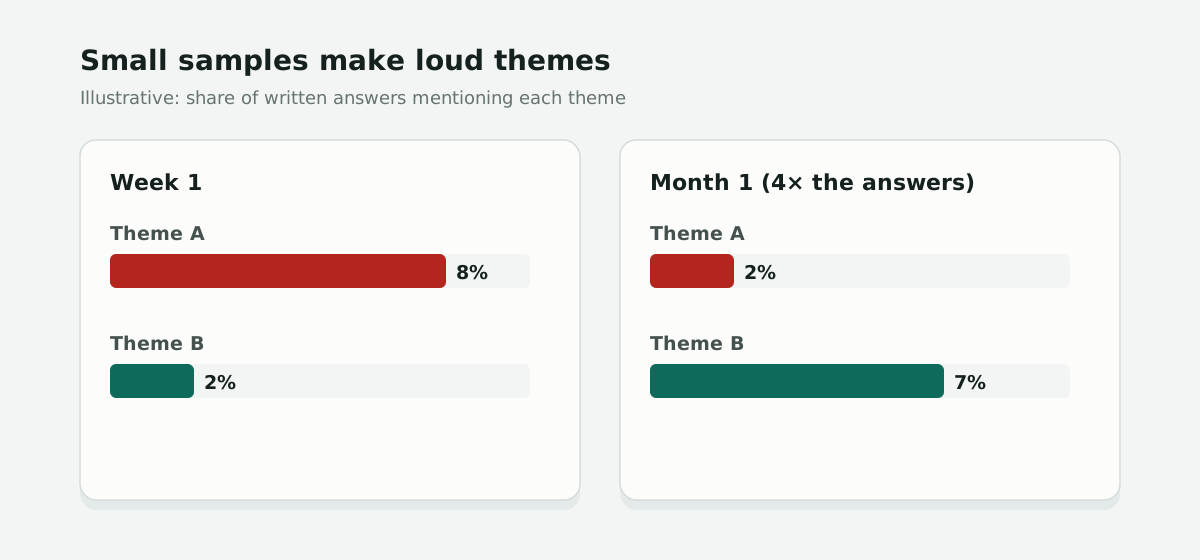
My first read used about a week of responses. One complaint looked like a real problem, mentioned in several percent of comments. With four times the data a month later, it had shrunk to about one percent. Another theme, sign-up friction, did the opposite and grew several times over.
Small samples make loud themes. Wait for a few weeks of answers before you act, and when you report, say how many responses the numbers rest on.
Make it a habit, not a project
- Run it all the time. A survey that's always on lets you compare this month with last.
- Re-run the same analysis. Same filters, same categories, so the numbers line up. Keep a short changelog of the dates and response counts.
- Use AI to sort the text, and read it yourself too. A language model is good at grouping thousands of comments into themes. Read a sample of the raw answers anyway, and quote real ones in your report. Verbatims persuade people in a way percentages don't.
Why this matters beyond the survey
An exit survey is one more place people tell you what they want, in their own words. So are the searches that bring them, the searches on your site, and their chat and form messages. The answers are already there. The work is reading them on the same scale, often enough to act.
Questions
What should an exit survey ask?
One question: why are you leaving? Offer a handful of fixed reasons and one optional text box. Fixed reasons give you trackable numbers; the text box gives you the specifics.
How many exit survey responses do I need?
There's no magic number, but a single week is rarely enough. Wait a few weeks before acting on a theme, and always report how many responses the numbers rest on.
Can AI analyze open-text survey answers?
Yes. A language model is good at grouping thousands of comments into themes. Read a sample of the raw answers yourself too, and quote real ones in your report.
Should I filter exit survey responses?
Filter to the markets and visitors you can actually sell to before counting. You want to know why likely buyers leave, not why everyone does.