Stop reporting organic traffic. Report who it brings.
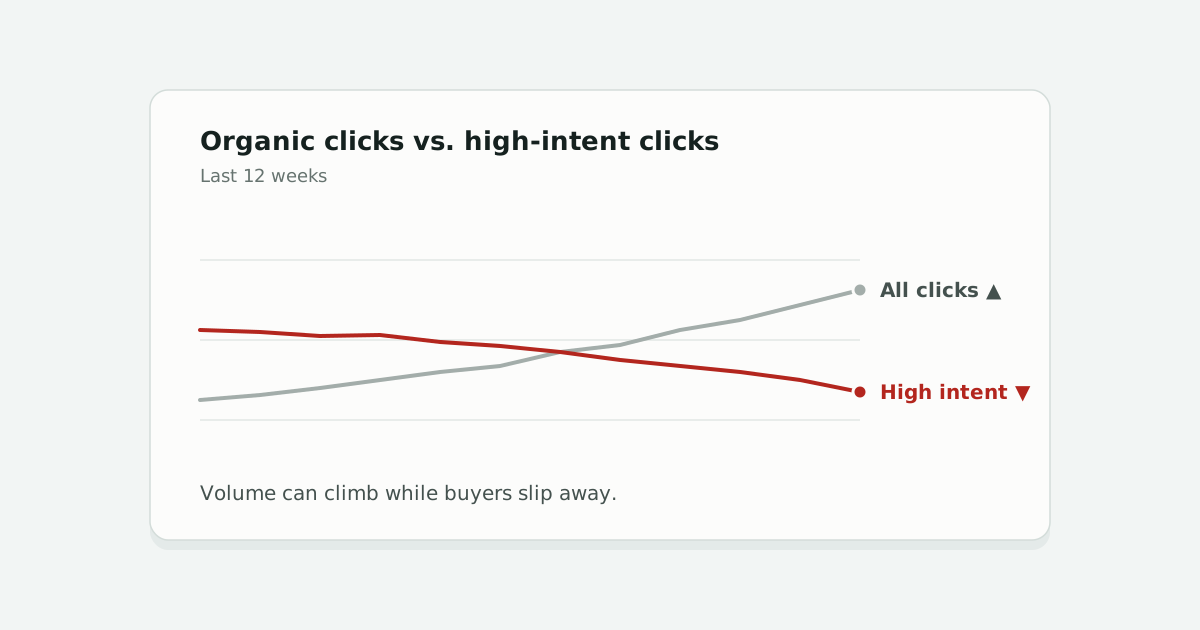
Most monthly SEO updates open with one number: organic clicks, up or down. It's easy to pull and easy to read, and it rarely tells leadership anything they can act on.
The problem is that clicks treat every visitor the same. Someone searching your brand name to log in counts the same as someone comparing you to a rival before a demo. So does someone looking for a free template who will never pay for anything. Add them up and you get a number that can rise while the people who actually buy quietly drift away.
At a previous company I built a tool to split our Search Console data by intent, and reported the split instead. It changed what the updates said.
The number that replaced it
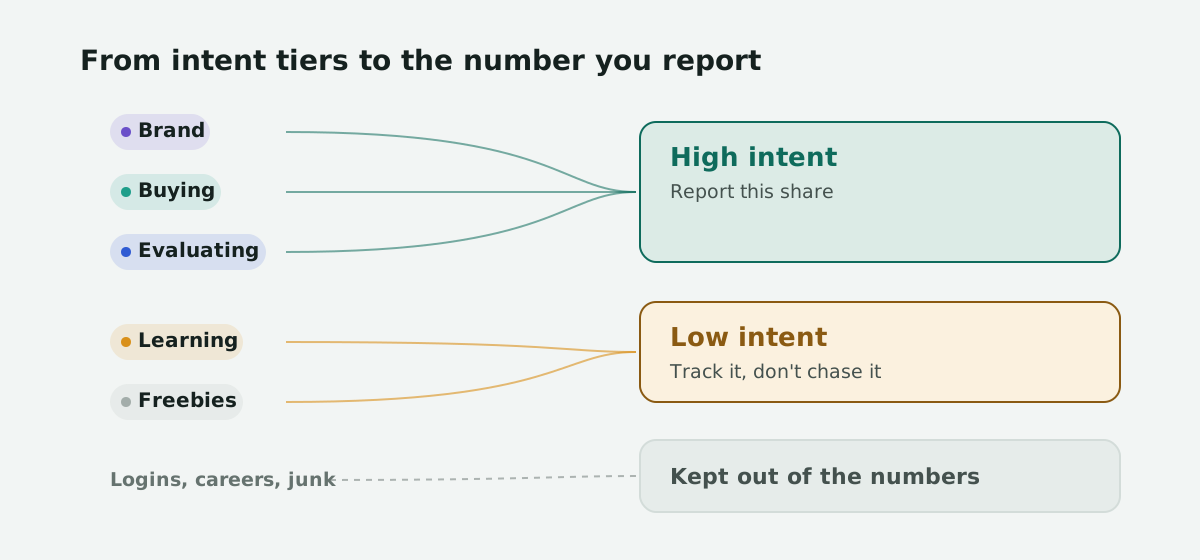
Every query gets one intent tier. I used a handful, then rolled them into two groups for reporting:
- High intent: brand searches, commercial searches (pricing, plans, buying), and research that only buyers do (comparisons, alternatives, specific features).
- Low intent: free stuff, entertainment, generic how-to, and anything the classifier couldn't place.
- Kept out entirely: logins, careers, and junk. They aren't demand, and leaving them in makes every number noisier.
The headline metric became high-intent share: high-intent clicks as a percentage of the total. Next to it, high-intent clicks as a raw number, because share alone can look great while volume collapses.
What the update sounded like after
The before and after is the whole point, so here it is with made-up numbers:
Before: "Organic traffic was up 8% this month."
After: "Organic traffic was up 8%, but nearly all of that was low-intent how-to traffic. High-intent clicks were flat, and brand searches dipped. We're looking at why."
The second version takes one more sentence and gives leadership something to ask about. It also protects you. A good month for total traffic stops being a reason to relax, and a bad month stops being a crisis if the buyers held steady.
A letter grade made the weekly check stick
Monthly reporting is slow to catch problems, so each week also got a single letter, A through F, built mostly from high-intent share.
A letter turned out to be the right size. A slide from A− to B+ with high intent falling was worth a look even when total traffic was flat, and that's exactly the case a volume chart hides.
I also folded in how much of the traffic was confidently classified. A grade built on guesses shouldn't look as solid as one built on clear queries, and it's honest to show that.
How I'd set it up again
- Pick your tiers before you look at the data. Decide what counts as high intent for your business, write it down, and stick to it. Changing definitions to make a month look better ruins the trend.
- Compare month over month first. That's the lens for "is something wrong." A three-month trend shows direction. Year over year is mostly for annual planning.
- Watch absolute clicks for small groups. A tier with a few hundred clicks can swing its share wildly. For those, the raw gain or loss is the more honest number.
- Check pacing mid-month. I ran the numbers twice a month: once halfway through to see if we were on track, once at the end for the real report.
- Keep the leadership summary to one paragraph. Did we hit the goal, what drove it, and what we're watching next. The intent split is the "what drove it" part.
What I'd do differently
I only did this for organic search. But search is one place people tell you what they want. Site search, chat, and form messages are the same signal, often closer to the buying decision, and nobody was grading them on the same scale.
That gap is why I'm building DemandGrade: one intent scale across Google searches, site search, chat, and forms, graded every week.
Questions
What counts as high-intent search traffic?
Brand searches, buying searches (pricing, plans, demos, comparisons with a rival), and evaluating searches (features, integrations, security). Learning searches and freebie hunting are low intent. Logins, job searches, and junk are best kept out of the numbers entirely.
Should I report high-intent share or high-intent clicks?
Both. Share tells you whether the quality of your traffic is improving. Raw high-intent clicks tell you whether volume is holding up. Share alone can look great while volume collapses.
How often should I check search intent?
A quick weekly check catches problems early, and a letter grade makes that check fast. Use a monthly report for leadership, with a mid-month look at pacing.
Does this only work for organic search?
No. Site search, chat, and form messages carry the same signal, often closer to the buying decision. The point is to put them on the same intent scale so the numbers compare.